

Shapes of a result
5 / 11 · trees, shared values, graphs in the full document · PDF
The field types of a view decide what a load returns. Plain fields make a tree of owned values, which can be cloned, compared and saved like any struct. Arc<T> shares one decoded value between everything that references the same row. Ref<T> makes the view a graph, held in an arena with each entity once, so cyclic data needs no depth limit. Recursive collections load a fixed number of levels, or every level in one recursive query.
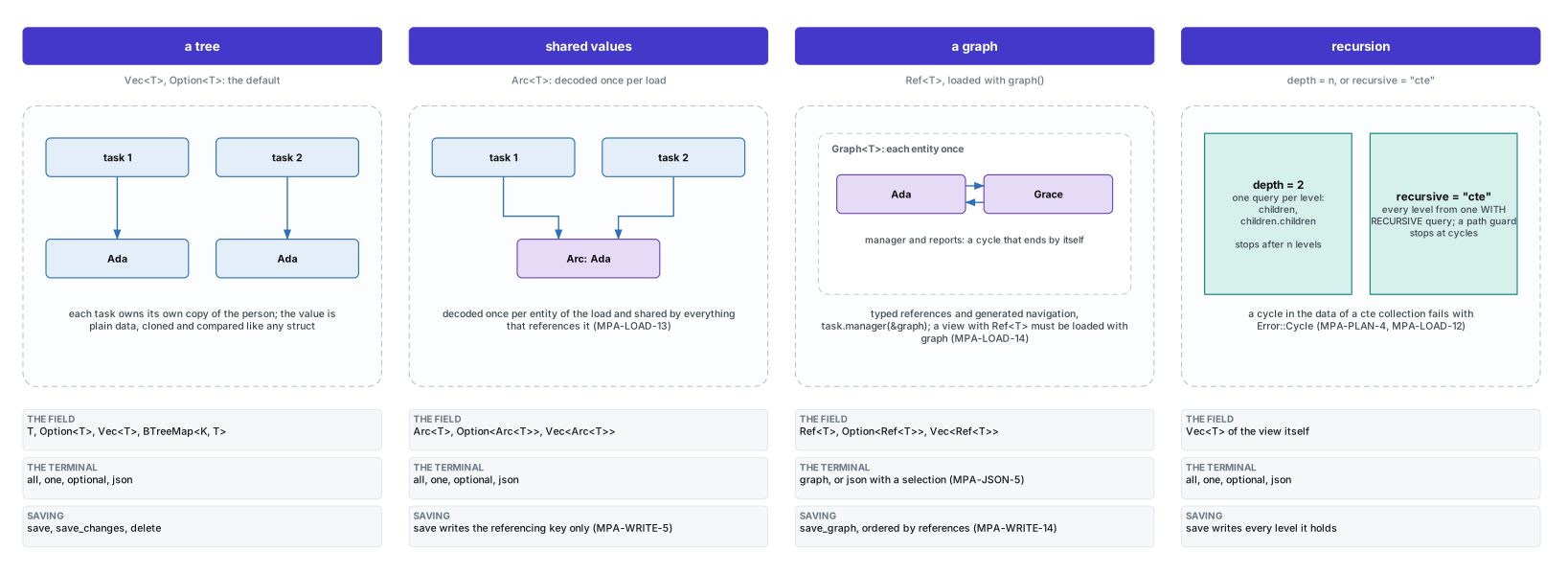
Trees and shared values. By default a reference or element is an owned value: two tasks with the same assignee hold two equal copies. An Arc<T> reference or element is decoded once per entity of a load and shared by everything that references it MPA-LOAD-13, which saves memory and decoding where the same rows recur. Collections are Vec, BTreeMap or HashMap of a view, of Arc or of Ref MPA-VIEW-10; a list placed by an index column fails on a NULL or repeated index MPA-VIEW-9.
Graphs. A view with Ref<T> fields is a graph and must be loaded with graph, else Error::GraphRequired. It returns a Graph<T> holding each entity once, with typed references and generated navigation methods such as task.manager(&graph); cycles end by themselves MPA-LOAD-14. A graph can be served as JSON only through a selection, whose finite depth unrolls it into a tree MPA-JSON-5. A graph is saved with save_graph: every entity, each after the entities it references, with the optional references of a cycle set afterwards MPA-WRITE-14 MPA-WRITE-15.
Recursion. A collection with depth = n runs its query again for each level, at most n levels; with recursive = "cte" every level comes from one WITH RECURSIVE query whose path guard stops at cycles, for a collection that contains its own view directly MPA-PLAN-4. A cycle in the data of a cte collection fails with Error::Cycle MPA-LOAD-12. A recursive view without either is a planning error: the depth of a tree must be known.